


Reinforcement Learning from Human Feedback (RLHF): A Human-Centric Approach to Training Smarter AI
Reinforcement Learning from Human Feedback (RLHF) is a machine learning technique that aligns model behavior with human values by training models using human-generated feedback rather than predefined rewards. Instead of relying solely on algorithmic rules, RLHF uses preferences or corrections provided by human evaluators to guide model updates.
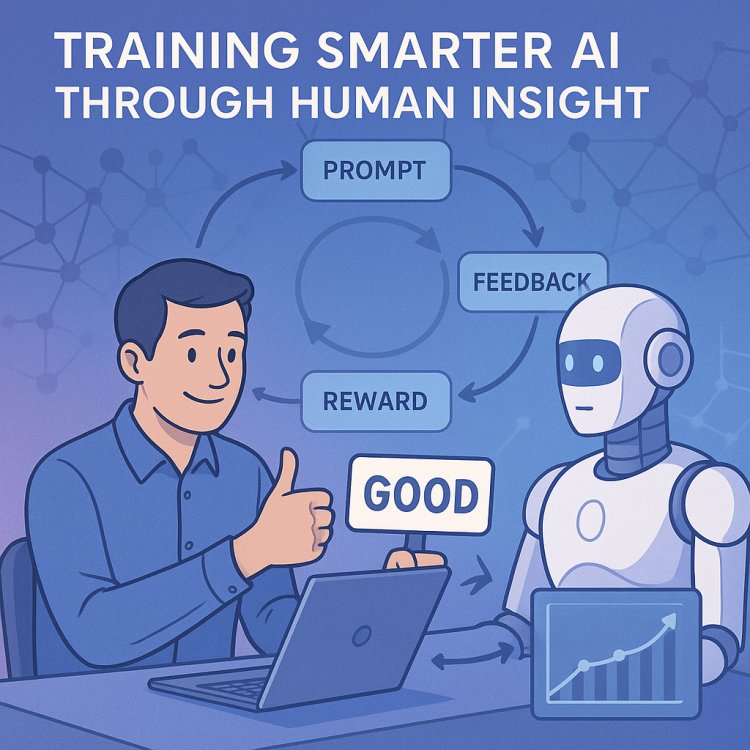


As AI systems grow more complex and powerful, ensuring they behave in line with human expectations becomes increasingly important. Reinforcement Learning from Human Feedback (RLHF) offers a promising solution by integrating human judgment into the training loop of AI models, particularly in language model development.
What is Reinforcement Learning from Human Feedback (RLHF)?
RLHF is a machine learning technique that aligns model behavior with human values by training models using human-generated feedback rather than predefined rewards. Instead of relying solely on algorithmic rules, RLHF uses preferences or corrections provided by human evaluators to guide model updates.
Why is RLHF Needed?
Traditional reinforcement learning can fail in subjective or ambiguous scenarios where it's hard to define a clear reward function. For example, when generating human-like dialogue or making ethical decisions, the “correct” behavior might be context-dependent or subtle. RLHF AI bridges this gap by letting humans teach AI models what’s acceptable or desirable.
Key Components of RLHF
| Component | Description |
|---|---|
| Pretraining | Model is first trained on a large dataset (e.g., the internet). |
| Human Feedback Collection | Human labelers rank or correct model outputs. |
| Reward Model Creation | A reward model is trained on the human feedback. |
| RLHF Training | Reinforcement learning uses the reward model to fine-tune the base model. |
Consideration Stage: Evaluating RLHF's Capabilities
How RLHF Works in Practice
-
Base Model Pretraining
A language model is pretrained on general data like web pages, books, and Wikipedia. -
Human Feedback Collection
Humans interact with model outputs—ranking them, suggesting edits, or flagging issues. -
Reward Modeling
A separate model learns to predict human preferences from the feedback data. -
Fine-Tuning via RLHF Training
The base model is further trained using reinforcement learning to maximize predicted reward (i.e., alignment with human judgment).
Real-World Applications of RLHF
Case Study 1: OpenAI's ChatGPT
OpenAI used RLHF Machine Learning to train ChatGPT. Human AI trainers provided conversation examples and ranked responses. This method improved safety and usefulness while reducing toxic or biased outputs.
Stat: According to OpenAI, models trained with RLHF showed 29% fewer toxic outputs than those trained with supervised fine-tuning alone.
Case Study 2: AI in Healthcare Communication
A health-tech firm employed RLHF AI to optimize its chatbot for empathetic patient conversations. Human doctors and nurses reviewed responses for tone, clarity, and empathy. The result was a chatbot that patients found 41% more helpful, increasing user trust and engagement.
Benefits of Using RLHF
-
Better Alignment with Human Values
-
Improved Safety and Reduced Harmful Outputs
-
Adaptability to Ambiguous or Ethical Scenarios
-
Enhanced Performance in LLMs (Large Language Models)
Challenges and Considerations
-
Scalability: Collecting human feedback is time-intensive.
-
Bias in Feedback: Human reviewers can introduce bias.
-
RLHF Paper Limitations: Research (like Anthropic’s RLHF paper) shows it may sometimes lead to over-optimization or reward hacking if not managed properly.
Decision Stage: Implementing RLHF in Your AI Strategy
When to Use RLHF
Use LLM RLHF when:
-
You want your AI model to produce nuanced, context-aware outputs.
-
There is no clear algorithmic reward function.
-
Safety, bias mitigation, or ethical alignment is crucial.
-
You're working with applications like conversational AI, content moderation, or personalized assistants.
Key Tools & Frameworks for RLHF Training
-
Proximal Policy Optimization (PPO) – Popular RL algorithm used in RLHF.
-
OpenAI’s Baselines & TRL – Tools for applying RLHF on transformer models.
-
Anthropic's RLHF Model Framework – Focuses on interpretability and safe alignment.
Comparison: RLHF vs. Traditional ML Approaches
| Feature | Traditional ML | RLHF Model |
|---|---|---|
| Reward Function | Predefined / rule-based | Learned from human feedback |
| Adaptability to Complex Judgments | Limited | High |
| Alignment with Human Values | Moderate | Strong |
| Human Involvement | Low | High |
| Performance in LLM Applications | Moderate | Excellent (e.g., ChatGPT, Claude) |
Preparing for RLHF Deployment
Steps to Implement RLHF AI:
-
Define Use Cases: Choose tasks that benefit from human feedback (e.g., summarization, translation, moderation).
-
Assemble a Human Review Team: Train annotators to evaluate outputs fairly and consistently.
-
Iterate and Monitor: Use feedback loops to continuously refine performance and safety.
-
Review RLHF Paper Insights: Analyze open-source research to avoid pitfalls and optimize your approach.
Conclusion
Reinforcement Learning from Human Feedback (RLHF) is transforming how AI models are trained and aligned with human values. From powering conversational agents like ChatGPT to enabling ethical decision-making in sensitive fields like healthcare, RLHF Training is setting a new standard for AI safety and effectiveness.
Whether you're exploring RLHF Machine Learning for research or deploying an RLHF Model in production, the path is clear: integrating human insights leads to smarter, safer, and more reliable AI.


![NeuroQ Reviews and Ratings:[NeuroQ Dosage] The Future of Cognitive Support](https://publicrelationsbox.com/uploads/images/2026/02/image_380x226_6996a3c2d763a.jpg)